Cyberpunk LED Chronometer
November 2020
Overview
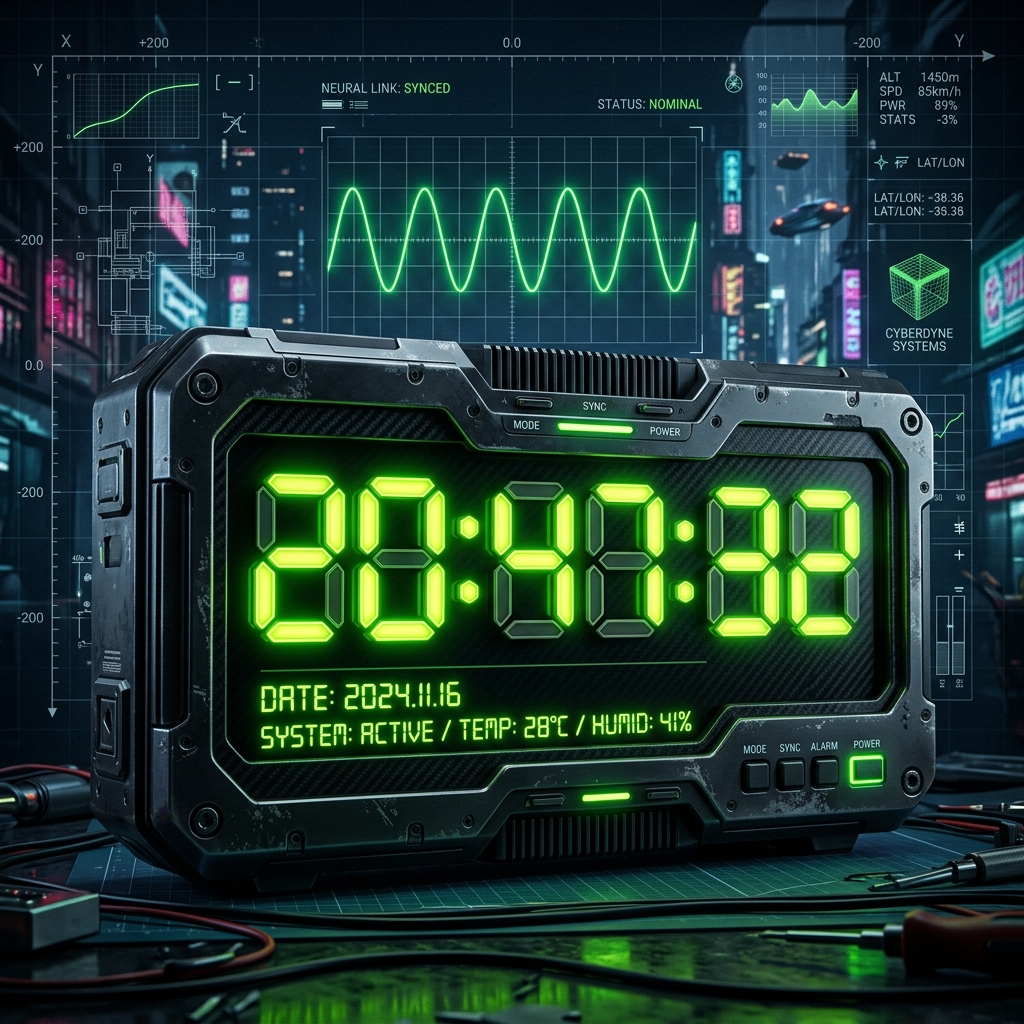
Seven-segment displays are electronic components used to display decimal digits by lighting combinations of seven segments. This project overhauls a basic binary segment switch script into an interactive Cyberpunk 7-Segment LED Chronometer simulating physical neon light scattering.
Key Features
- Procedural Segment Rendering: Draws segments as bevelled hexagons with angled tips to mimic physical hardware screens.
- Neon Glow Physics: Uses the HTML5 Canvas shadow API (
shadowBlurandshadowColor) to simulate realistic photons scattering around active glowing segments. Inactive segments are drawn as faint, ghosted grids. - Multiple Color Presets: Switch display colors dynamically (Neon Cyan, Toxic Lime, Hot Fuchsia, Amber Gold, or Quantum Purple).
- Time Accelerator Slider: Accelerates virtual time (up to 1000x) via a range slider to watch dates increment and segments transition.
- HUD Blueprint Ticker: Integrates a background blueprint coordinate grid with an animated sine-wave oscilloscope ticker showing the passage of seconds.
- Calendar Strip: Displays procedurally aligned dates (DD/MM/YYYY) and days of the week.
Technical Implementation
The application is written in ES6 JavaScript with the p5.js canvas framework. Individual digits are parsed into separate arrays representing segment active states [A, B, C, D, E, F, G]. Active states draw beveled coordinate hexagons, while inactive states draw with zero shadow to look like deactivated hardware bulbs.
Technologies Used
- p5.js for canvas rendering, blueprint overlays, and color mappings
- ES6 JavaScript for digit array bitmasking and custom clock accumulators
- HTML5 & CSS3 for modern glassmorphic dashboard panel layouts
- HTML5 Canvas Shadow API for neon glow blurs
What I Learned
This project provided valuable experience in:
- Implementing boolean bitmasks to translate integer states into visual layouts.
- Working with shadow blurs and styling to represent realistic physics-based light scattering.
- Creating procedural polygon layouts (beveled hexagons) with thickness and scale calculations.
- Integrating secondary data feeds (calendar strings) into a uniform layout.