Day & Night Observatory
December 2021
Overview
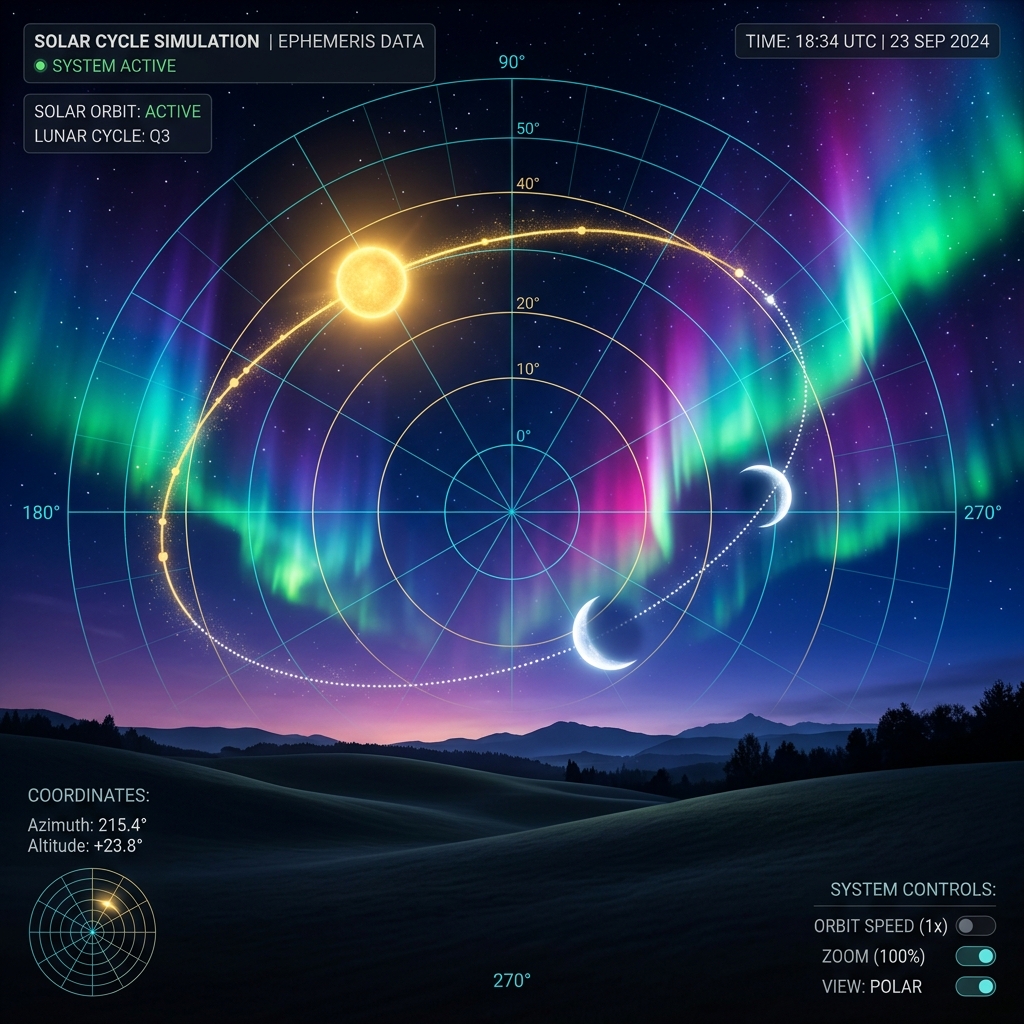
Modeling day/night atmospheric transitions requires complex color math and ambient shading logic. This project overhauls a basic asset-dependent sunset sketch into an interactive, self-contained Procedural Solar Cycle & Day/Night Transition Visualizer running 100% on vector coordinates.
Key Features
- Multi-Stop Color Interpolation: Shaders interpolate sky background bands across five primary day/night stops (Midnight, Dawn, Noon, Dusk, Midnight) using
lerpColor()vertical gradients. - Dual Orbit Mechanics: Calculates opposite $180^\circ$ phase-shifted solar and lunar coordinate locations using polar-to-cartesian conversions:
x = R_x · cos(θ)y = R_y · sin(θ)
- Ambient Lighting Shading: Dynamically shades mountain silhouetted trees and hills using cosine time mappings (e.g., darker at midnight, fully lit at noon).
- Interactive Scenery Elements: A procedural cabin window lights up with a warm orange neon glow during nightfall and turns off during daytime.
- Weather Atmosphere Themes:
- Northern Lights: Floating neon green/teal wave bands drawn with curved Bézier vertex lines.
- Starry Cluster: Twinkling background stars that fade out as dawn approaches.
- Deep Forest Fog: Falling rain particle vectors accompanied by a thick white mist overlay.
Technical Implementation
Built with vanilla ES6 JavaScript and the p5.js canvas framework. In order to bypass browser local file loading locks (CORS) under file://, the application replaces all external image asset reads with procedural polygon drawings. An auto-orbit time scroller cycles through 0.0 to 24.0 hours, controlling the celestial angles and light intensities.
Technologies Used
- p5.js for coordinate vectors, curved curves drawing, and linear color interpolation
- ES6 JavaScript for particles updating loops and state selectors
- HTML5 & CSS3 for glassmorphic sidebar panel layouts
- Polar-to-Cartesian Math for orbiting trajectories
What I Learned
This project provided valuable experience in:
- Mapping multi-stop gradient color transitions across a continuous numerical scroller.
- Working with ambient light scalar factors to shade layered graphics dynamically.
- Designing self-contained procedural vector art structures to eliminate CORS asset loading dependencies.
- Modeling atmospheric states (aurora, rain, fog) using mathematical equations.