Interactive Fractal & Chaos Suite
May 2022
Overview
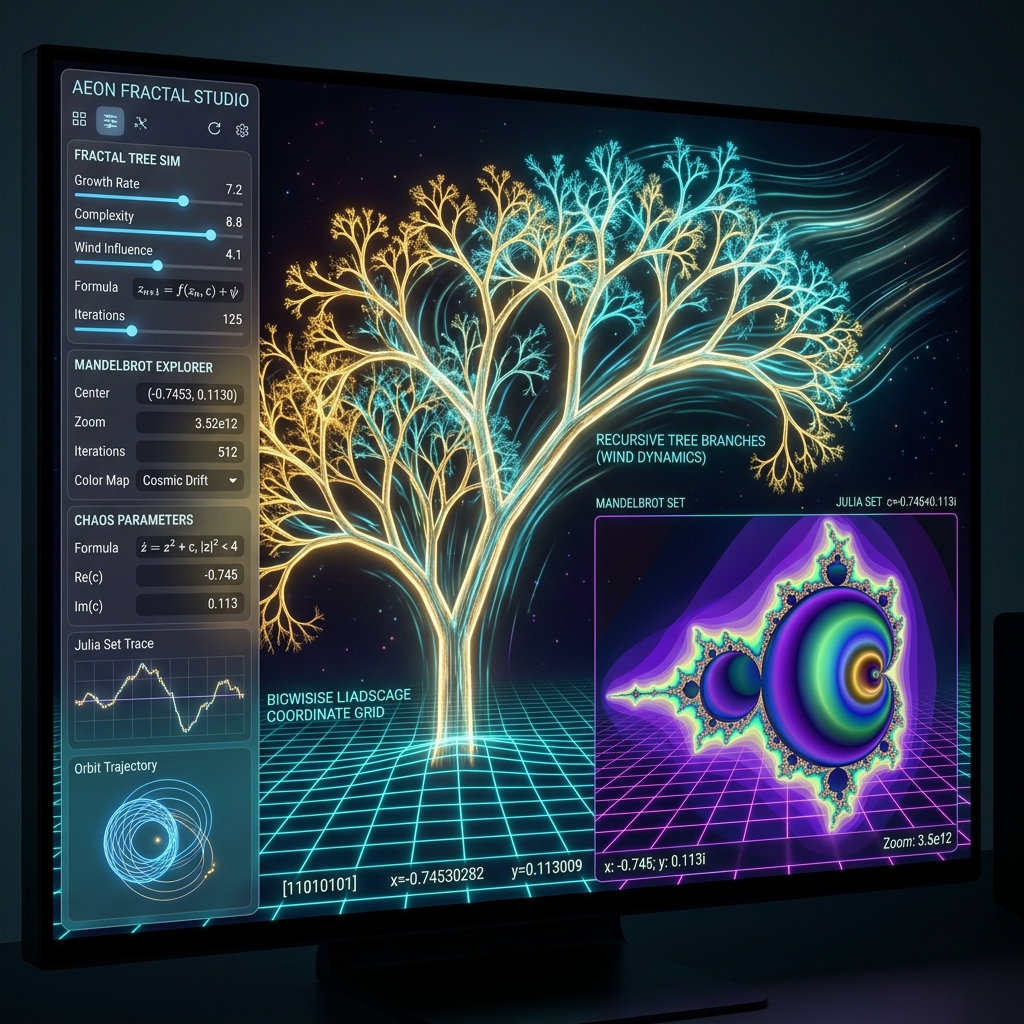
Fractals represent curves with fractional, non-integer dimensions that display self-similarity across infinite scales. This project overhauls a basic pixel-scatter script into a comprehensive Interactive Fractal & Chaos Theory Suite. It includes multiple rendering engines exploring organic wind forces, complex number iteration orbits, and binary logic table geometries.
Key Features
- Four Visual Modes:
- Bitwise Landscapes: Explores boolean AND/OR/XOR pixel coordinate grids.
- Recursive Tree: Generates organic branching networks.
- Mandelbrot Set: Renders complex numbers escaping $z_{n+1} = z_n^2 + c$ boundaries.
- Julia Set: Interactively morphs complex constants using mouse-movement vectors on the canvas.
- Organic Wind sway: Combines 1D Perlin noise gradients with recursive branching matrices to animate natural branch swaying.
- Dynamic Resolution Optimization: Employs pixel-scale rendering step controls (low-res during slider interactions and mouse drags, full-res when static) to guarantee a responsive 60fps environment.
- Dark Glassmorphic UI: Dashboard containing custom slider widgets and mathematical formula info boards.
Technical Implementation
Built with vanilla ES6 JavaScript and the p5.js canvas environment. The complex sets utilize low-level pixel array modifications (loadPixels/updatePixels) to optimize iterating over 260,000 coordinate pixels up to 150 times per frame.
Technologies Used
- p5.js for visual canvas loops and trigonometry matrices
- Vanilla JavaScript (ES6) for optimization loops and event bindings
- Perlin Noise algorithms for natural wind animations
- CSS Grid & Flexbox for styling glassmorphic sidebar layout control panels
What I Learned
This project provided deep insights into:
- Bypassing browser rendering bottlenecks by writing optimized inline loops.
- Working with complex numbers and coordinate transformation math.
- Blending mechanical geometric rules with natural gradient noise forces to simulate organic behavior.
- Designing reactive UX systems that adapt rendering resolution to client input states.