Mechanical & Celestial Chronograph Suite
October 2021
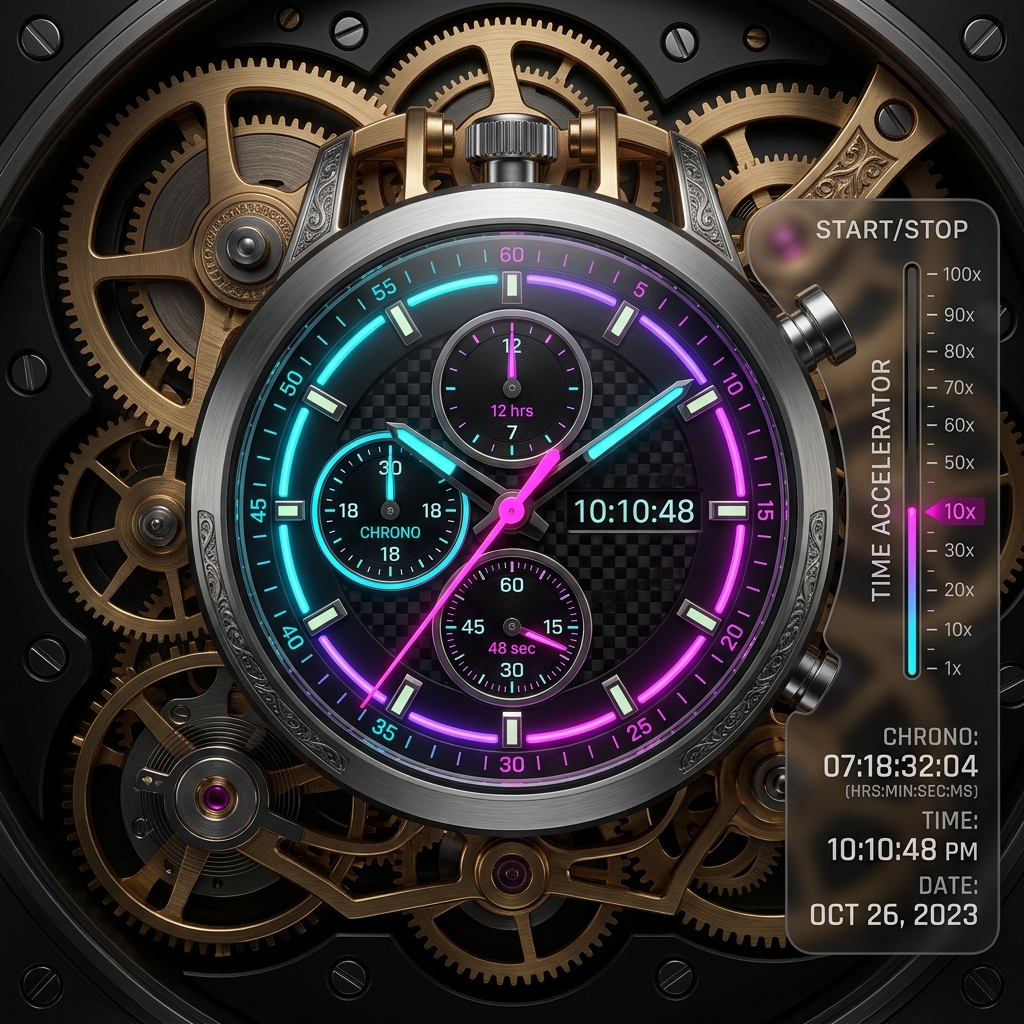
Overview
A chronograph is a specific type of watch that combines classic timekeeping with independent stopwatches. This project overhauls a basic analog second-hand sketch into a premium Mechanical & Celestial Chronograph Suite exploring the physics of gear tooth mesh ratios and polar coordinate orbital mappings.
Key Features
- Three Aesthetic Themes:
- Steampunk Brass: Features interlocking gears rotating at synchronized mechanical velocity ratios.
- Celestial Astronomy: Twinkling stars backdrop with a 24-hour day/night sun/moon orbit disc.
- Modern Onyx: Minimalist watch face with neon cyan, purple, and fuchsia circular progress arcs.
- Interlocking Gear Simulation: Simulates escape wheel and mainspring wheel cog teeth meshing in the background.
- Speed Time Slider: Accelerates virtual time (up to 500x) so users can watch gear trains and day/night cycles orbit in fast motion.
- Continuous Sweep vs Ticking: Instantly switch second-hand movements between smooth sweep (mechanical automatic) and stepping ticks (quartz).
- Stopwatch Sub-dial: Fully operational bottom sub-dial with split lap displays in the sidebar.
Technical Implementation
Built using vanilla ES6 JavaScript and the p5.js canvas environment. Rather than fetching local clock parameters directly, the application runs a customizable virtual clock epoch. The speed slider scales the frame rate delta times (deltaTime) before adding them to the custom epoch, allowing smooth time acceleration.
Technologies Used
- p5.js for coordinate translations, trigonometry orbits, and gear teeth drawing shapes
- ES6 JavaScript for clock state tracking and event bindings
- HTML5 & CSS3 for modern glassmorphic dashboard panel overlays
- Polar-to-Cartesian Math for rotating pointer hand coordinates:
x = R · cos(θ)y = R · sin(θ)
What I Learned
This project provided valuable experience in:
- Coordinating multiple visual states and drawing matrices under a central controller.
- Modeling physical machine linkages (meshed cogs) using synchronous rotation equations.
- Structuring modular theme layouts that dynamically swap color assets, fonts, and render functions.
- Running time-accumulators independent of native system clocks.