Advanced Scientific & Mathematical Simulations Suite
June 2022
Overview
Modern web browsers are capable of running complex scientific computations and displaying them in real-time. This project is an interactive visual sandbox designed to demonstrate advanced concepts in mathematics, wave physics, orbital dynamics, and signal processing using the p5.js canvas environment.
Key Simulations
The suite includes several high-fidelity simulation engines:
- Black Hole Gravitational Lensing: Deflects photon null geodesics around a Schwarzschild black hole, rendering unstable photon spheres and warped accretion disk halos.
- Double Pendulum Lagrangian Chaos: Solves non-linear coupled Euler-Lagrange equations to demonstrate exponential trajectory divergence and deterministic chaos.
- Quantum Tunneling Transistor: Computes Schrödinger probability wave packet decay and transmission coefficients through sub-nanometer potential barriers in modern semiconductors.
- Chladni Resonance Plates: Simulates standing acoustic wave interference and particle gradient descent in 2D biharmonic vibrating plates.
- Turing Morphogenesis: Integrates Gray-Scott reaction-diffusion PDEs ($u, v$) to model spontaneous symmetry breaking, leopard spots, and zebra stripes.
- MIMO Beamforming Array: Visualizes constructive and destructive superposition of radio frequency (RF) wavefronts from multiple antenna elements with adjustable phase delays.
- Grand Tour Gravity Slingshot: Simulates spacecraft planetary flybys, kinetic energy transfers, and gravitational pull using Runge-Kutta 4th Order (RK4) integration.
- Conformal Grid Warper: Maps complex analysis holomorphic transformations (such as $z^2$, $e^z$, and $\sin(z)$) while preserving intersection angles on the complex plane.
- RF Signal Modulation (QAM): Simulates cell link capacity, constellations, and Bit Error Rates (BER) under additive white Gaussian noise (AWGN).
- Coriolis Space Habitat: Compares straight-line trajectories in inertial frames side-by-side with fictitious force curvature in rotating reference cylinders.
- Kessler Debris Cascade: Models orbital decay and collision chain-reactions of Keplerian satellite fragments in Low Earth Orbit (LEO).
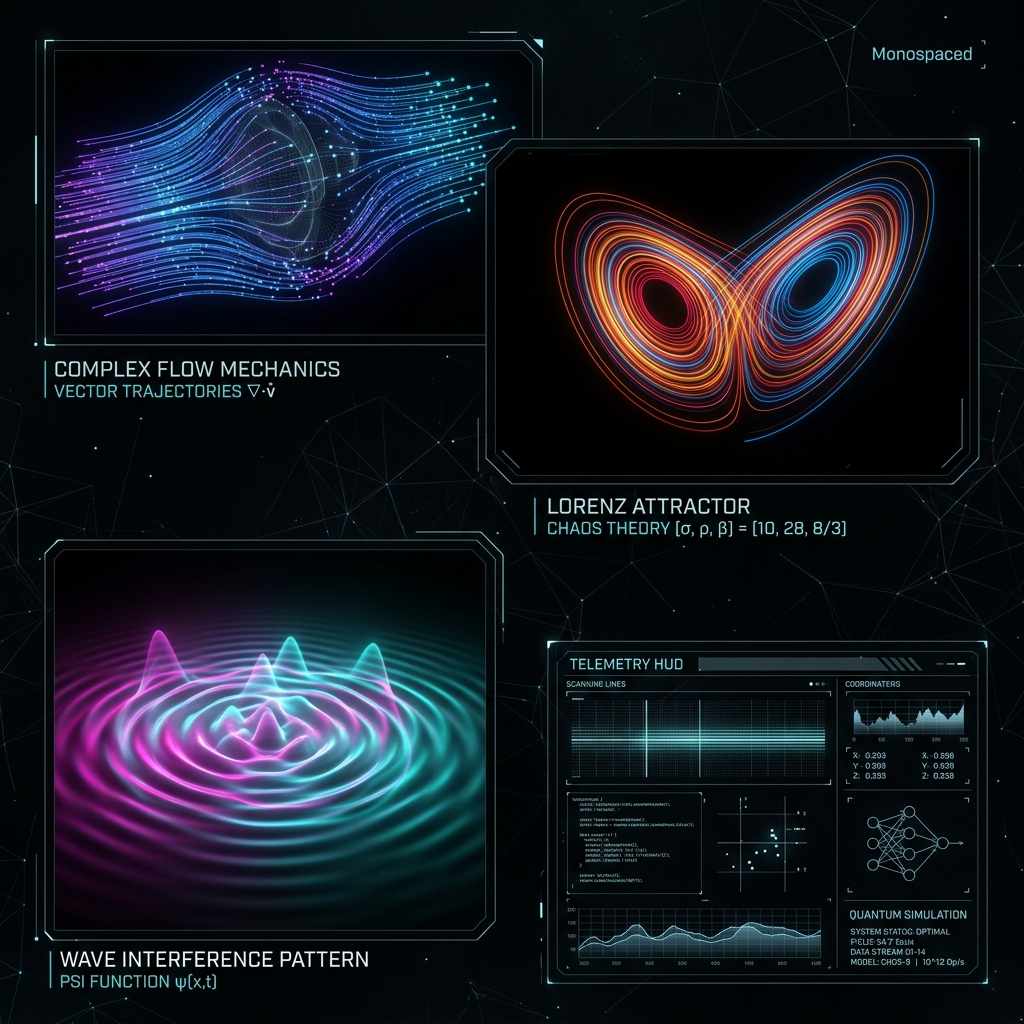
- Strange Attractors (Lorenz 3D): Visualizes phase-space divergence and chaos theory using 3D differential equations.
Technical Implementation
All models are written in native ES6 JavaScript utilizing p5.js for high-frequency drawing loops. Numerical integrations like Runge-Kutta (RK4) and Verlet integration are used to ensure stable physics loops. Complex mathematical operations are performed using custom vector algebra classes optimized for matrix transforms.
Technologies Used
- p5.js for 2D/3D graphics, path tracing, and coordinate transformations
- ES6 JavaScript for physics integrations, signal processing algorithms, and event bindings
- HTML5 & CSS3 for modern responsive HUD elements and telemetry layouts
- Runge-Kutta Integration (RK4) for high-accuracy gravitational orbit calculations
What I Learned
This project provided deep experience in:
- Implementing numerical integration techniques (RK4) to maintain conservation of energy in orbital physics.
- Translating complex mathematical concepts (complex analysis conformal mappings, wave physics superposition, quantum wave probability) into intuitive visual representations.
- Optimizing CPU-intensive drawing routines to maintain 60fps when plotting hundreds of particles or complex waveforms.
- Designing responsive, high-contrast dashboards that lay out raw telemetry data alongside interactive controls.